

The discovery of posters bearing Islamophobic messages on campus Sunday evening has raised concerns about the safety of Muslim students.
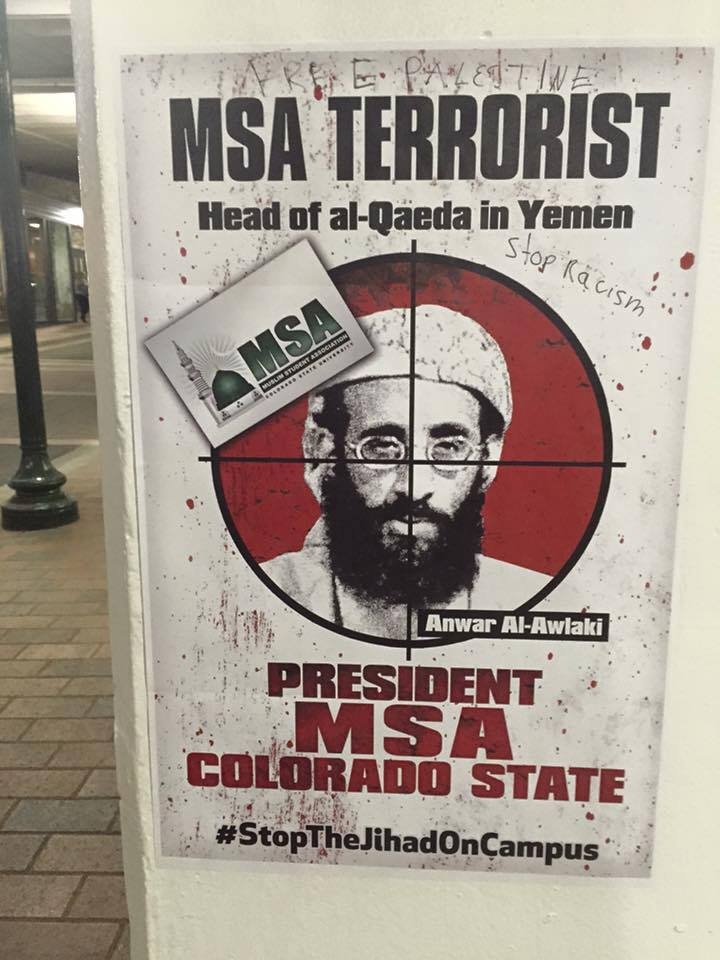
The posters mentioned chapters of the Muslim Students Association and Students for Justice in Palestine. One depicts deceased al-Qaeda member Anwar al-Awlaki with a target over his face. The picture on the poster is surrounded by the words, “MSA Terrorist: Head of al-Qaeda in Yemen, President MSA Colorado State” and the hashtag “#StopTheJihadOnCampus.” A 2010 New York Times article confirms that al-Awlaki attended Colorado State, but there is no evidence that he was president of the school’s MSA chapter.
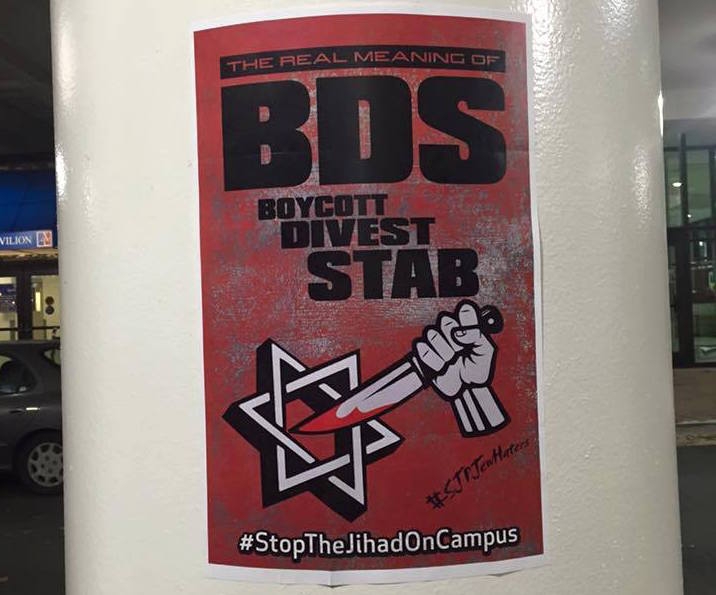
Another poster, which bears the same hashtag, shows a bloody knife hovering over a Jewish star under the words, “The real meaning of BDS: Boycott, Divest, Stab.” This phrase draws a reference to “Boycott, Divestment and Sanctions,” a strategy used by Students for Justice in Palestine chapters and other organizations to protest Israel’s political treatment of the Palestinian territories.
Students found two posters in the tunnel next to Bender Arena and four more on lampposts between Kogod and Katzen.
Aman Abdelhamid, the president of AU’s MSA chapter, said she felt severely troubled by the posters.
“We’ve been dealing with [Islamophobia] our entire lives, but to come to a school and to have fliers posted like that with threatening images…it’s just so upsetting,” Abdelhamid said.
The posters are linked to “Stop the Jihad on Campus,” a campaign funded by the California-based David Horowitz Freedom Center. A statement that the Office of Campus life e-mailed to the student body Tuesday afternoon connected the posters to the Freedom Center, and the group’s website claims the organization “combats the efforts of the radical left and its Islamist allies to destroy American values and disarm this country as it attempts to defend itself in a time of terror.”
Horowitz’s materials have appeared on campuses across the country, according to Abdelhamid.
Members of the MSA and SJP found a 44-page manifesto on the website for the “Stop the Jihad on Campus” campaign. The document claims that MSA and SJP university chapters were founded by the Muslim Brotherhood and are funded by al-Qaeda and Hamas. None of this is true, according to Laith Shakir, treasurer of AU’s SJP chapter. Both organizations’ budgets are financed through AU Club Council, he said.
“Not only is all of the information presented here categorically false, it also propagates an exhausted talking point: if you are (or even just look) Muslim, and you’re involved in campus organization, you must also be involved in a terrorist group,” Shakir wrote in a Facebook post Sunday night. “Thus, Muslims and people who ‘look Arab’ are inextricably linked to violent extremism. The promoted hashtag isn’t trying to just ‘stop the jihad’ (which, itself, is a nonsensical phrase); instead, it’s trying to eradicate anyone who could conceivably be labeled as Arab or Muslim from organizing on campus.”
Shakir was one of several students who shared pictures of the flyer on Facebook. Many urged their peers to report the incident to Public Safety. Some also offered to walk with Muslim students who did not feel safe traveling alone, Mokuena said.
The posters have made Muslim students feel unsafe, according to Abdelhamid.
“I had people calling me [on Sunday], telling me that they were legitimately scared,” she said. “The posters…had really strong implications, really threatening messages.”
The discovery of the posters coincided with instances of Islamophobia on other campuses in the DMV area, Abdelhamid said. The same posters were recently spotted on the Georgetown and George Washington University campuses. At Virginia Tech, students found the message, “On 11/11, we will kill all the Muslims,” written on a bathroom stall, Abdelhamid said.
The fact that the posters originated from an outside organization, Abdelhamid said, will not be comforting until the people who put them up are identified.
“The thing is, we don’t know who posted these flyers,” she said. “It was definitely on behalf of that organization, but we don’t know if they sent people from the organization to come on campuses, or whether they recruited actual students.”
On Sunday night, SJP president Ntebo Mokuena brought one of the posters found in the tunnel to the Public Safety office, where she filed a written report. An officer escorted her to the tunnel to take down the other poster there and walked with her to MGC to look for more. She said she was told that officers would be available to escort any students across campus, and that they would search the campus for more posters.
Members of the MSA and SJP raised concerns about the posters in a meeting with representatives from the Kay Spiritual Life Center, Public Safety, Student Activities and the Office of Campus Life Monday afternoon. Shakir said that Zinab Attai, MSA’s Community Liaison, expressed disappointment with some aspects of Public Safety’s response.
Although officers assured Mokuena and others Sunday night that they would find and remove as many posters as they could, Attai said she saw four posters near Kogod on Monday morning. Three Public Safety officers were standing near one of them, she said, so she assumed it would be taken down. When she passed by the area three hours later, the officers were gone, and the poster was still there. She took it down herself, despite fears of being targeted by the people who put them up.
Public Safety did not issue a public statement or email alert, despite requests from MSA and SJP members. Request for comment from Public Safety by The Eagle were not returned in time for publication.
Both organizations said they were also concerned by the University’s lack of protocol for dealing with hate speech.
“The University had good intentions, but they said a lot of what is going to be done is going to happen through the community,” Abdelhamid said. “And I understand that … community involvement and awareness is a huge part of the whole situation, but the administration needs to do their part. We need to know that the University knows how to deal with these kinds of threats.”
Shakir said he was also troubled by the University’s response.
“As students and members of a marginalized community, we didn’t know where to go after being specifically targeted with violent messages,” he said. “Part of our hope is that this will serve as a case study for the University going forward, to have a protocol in place to allow students to know how the University will respond to hate crimes before that happens, and to serve as a sort of preventative measure.”
Gail Hanson, the vice president of Campus Life, said AU does not have a hate speech policy. There is a set ofFreedom of Expression Guidelines, which she said outlines the cases in which the University can intervene in student speech.
“Protest or demonstration shall not be discouraged so long as neither force nor the threat of force is used, and so long as the orderly processes of the University are not deliberately obstructed,” the policy states.
Prohibited “expressions of dissent” include those that “deny or infringe upon the rights of other students, faculty, staff, or guests of the University community…disrupt or interfere with educational or other activities of the University community…[or] endanger the safety of any person on the University campus.”
The guidelines do not apply to people from outside the AU community, Hanson said. In accordance with University policy, only students, staff and faculty are allowed to place posters on campus. The organizations or individuals responsible for the content must make their names visible on all posted materials. Posters put up by outsiders will be removed, Hanson said.
Shakir said the posters are “emblematic of a much larger mentality” of animosity toward SJP chapters and Islamophobia.
This is not the first time AU’s SJP chapter has encountered hostility, according to Mokuena. She said that the group’s posters are frequently defaced or ripped down.
The MSA, SJP, the University and AU Hillel have issued statements condemning the posters.
“I am profoundly upset and displeased at the inflammatory posters that went up over the weekend,” University Chaplain Joe Eldridge said in an interview. “It is incumbent on us as an American University community to surround our Muslim brothers and sisters with compassion.”